introduction
We build and back ventures addressing Earth’s critical life support systems. Through catalytic programmes and founder first investment, we scale ventures with the power to transform industries and safeguard the Earth. Those who shape the future don’t wait for permission, they build it. These are exactly the sort of founders we work with.
Our mission is not just a philosophy, it is a science. Reporting on our impact each year is part of that discipline: it is how we hold ourselves to the same standard of evidence we ask of the founders we back, and how we track whether our thesis is actually playing out.
By the end of 2025:
102 investments made since 2021
19 programmes run since 2021 (5 Venture Launchpads + 15 Venture Builders)
926 Mt CO2e of planned impact by 2050
65% of ventures include a female founder
60/40 split of hardware to software solutions
€13.3M of capital mobilised
2025 was also the year climate tech’s resilience became harder to argue with. Global climate tech venture and growth investment reached USD 40.5 billion in 2025, up 8% year on year, bringing cumulative investment since 2020 to USD 255 billion. Investors have become more selective, not absent.
“This report is not a conclusion, but a checkpoint and an honest look at where we are and where we need to go”
Dr. Nicky Dee
In 2025, solar PV led global primary energy growth for the first time on record, accounting for more than a quarter of the total, while renewables and nuclear together met nearly 60% of all growth in energy demand. The failure to attribute impact is no longer structural either. Satellites such as MethaneSAT and the GHGSat constellation now detect methane plumes at facility resolution, ground sensors and digital twins verify emissions and resource flows across supply chains, and regulation is catching up, from CBAM to EPR. Climatetech is interesting for exactly this reason: it is both a horizontal layer, cutting across energy, materials, food, the built environment, and finance, and a vertical thesis within each of those industries, where defensibility and willingness-to-pay are finally becoming legible.
PLANNED IMPACT: HOW WE SIZE WHAT A VENTURE COULD ACHIEVE
Every founder who joins a Carbon13 programme leaves having received training in planetary health, impact, and building a scalable venture. Each company must then submit a Carbon Case to our Investment Advisory Committee, a framework that explains the venture’s impact rationale.
HOW BIG CAN IT BE?
This is the second of three questions every Carbon Case has to answer, and it is where planned impact gets sized. It is illustrated in tCO2e, though other metrics of equal ambition apply, and it works from three layers:
- TAC, Total Addressable Carbon: all emissions the problem touches.
- SAC, Serviceable Addressable Carbon: what’s reachable with this solution.
- SOC, Serviceable Obtainable Carbon: what’s realistically obtainable.
It’s top down market sizing meeting bottom up unit economics, and it’s what sits behind our ambition of up to 10 MtCO2e per year for any single venture, and behind the 926 Mt CO2e of planned impact by 2050 across the portfolio.
Ventures get to sense check their Carbon Case with a Carbon Expert and with Carbon13 during the programme, to stress test their impact thesis. The Investment Advisory Committee invites external experts to join and evaluate each venture’s proposal, and a Scientific and Technical Advisory Committee (STAC) provides oversight on our approach as a whole.
ADDITIONALITY: WHY DOES IMPACT HAPPEN, AND WILL IT LAST?
This is the first question every Carbon Case has to answer, and it’s the one that keeps planned impact honest. It asks for the key assumptions behind a venture’s impact claim, the indicators, horizon, and causality, and it asks founders to name the impact risks: will the effect be permanent, and could it shift the problem elsewhere rather than solve it (a counterfactual shift)?
The second question, on sizing, carries the same discipline: additionality logic versus the counterfactual. A venture’s impact only counts if it wouldn’t have happened anyway. That is also why we treat a venture’s own Scope 1 to 3 footprint, measured early to identify hotspots and priority decarbonisation opportunities, as hygiene, not the impact claim. A low footprint on its own proves nothing about whether a venture is additional.
The J Curve: planned impact over time
Many impact reports present a single number for tonnes of carbon dioxide equivalent avoided, or projected to be avoided, across the portfolio. That’s fine as a headline, but against a dynamic portfolio it can feel like a target rather than something that helps evaluate impact over time.
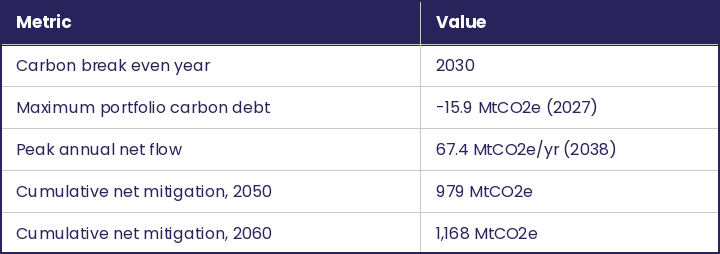
Returning to modelling Nicky started a few years ago, we reframed future impact by taking into account the trajectories of ventures over time, looking at net impact rather than just the upside. Using a conventional VC distribution with parameters derived from Carbon13’s own J Curve model, the portfolio to date (2021 to 2025) looks like this:
Designing for success: diversity from day one
Too many critical solutions to achieving net zero are being overlooked, because the people most affected by climate change are often excluded from building them. That’s why we’re committed to inspiring, supporting, training, and funding female founders and other underrepresented groups driving climate innovation.
THE GAP WE’RE WORKING AGAINST
In 2025, female founded startups raised €7.5B, the highest amount in three years and a 19% year on year increase. Yet gaps remain: only 13% of total VC capital raised by startups of all genders in Europe was raised by women, 10.4% of VC investment went to female co-founded businesses in 2024 while all-male teams received over 80% of capital, and just 2% of equity investment went to all-female founding teams in 2024. The pipeline challenge starts early too: women make up just 1 in 3 STEM graduates in the EU, and only 1 in 5 ICT specialists.
WHERE CARBON13 STANDS
By the end of 2025, 65% of Carbon13’s invested ventures had a female founder. This is not a coincidence, but the result of targeted outreach and hands on support for female founders throughout the entire venture building journey, and we have consistently ensured at least 30% female founder representation in every cohort.
To help address the structural barriers women founders face, Siemens Energy Ventures partnered with Carbon13 to launch the Female Equity Scholarship, combining financial support with one to one mentoring from experienced female leaders within Siemens Energy. By the end of 2025, 26 female founders had been supported through the programme, with many more to come.
Diversity doesn’t exist in a single dimension. While gender diversity is a cornerstone of our approach, ethnicity is equally vital in shaping the richness of thought that drives innovation. People from different cultural backgrounds bring distinct lived experiences, perspectives, and ways of framing problems, creating the cognitive diversity that unlocks breakthrough thinking. What gets measured gets addressed, which is why we monitor and report on the diversity of every cohort we build.
Read the report
This covers four of the questions we get asked most: how we size planned impact, how we test for additionality, what our J Curve tells us about impact over time, and how we’re building diverse founding teams from day one. The full 2025 Impact Report goes further, including our full portfolio, our Scope 1 to 3 footprint, and our first year of SFDR Article 9 reporting.
What next? Join the mission! Found Follow Invest.
If you want to found a high potential venture that addresses Earth’s planetary boundaries, then apply to one of our programmes, applications open very soon.
Follow our work through our newsletter or social media to stay up to date with the forefront of climate innovation in Europe.
Investors can explore supporting Carbon13’s funds or our ventures directly. We run events, share insights and deals with our investor community. To join this, simply reach out to us on investors@carbonthirteen.com
Carbon13’s SEIS Fund X is open now for this tax year. To download the IM please visit our fund partners Syndicate Room.
Don’t invest unless you’re prepared to lose all the money you invest. This is a high-risk investment and you are unlikely to be protected if something goes wrong. Take 2 mins to learn more here https://www.syndicateroom.com/risk-warning