Aiming to recover one billion tonnes of methane emissions from global water systems, Bluemethane is working with multiple industry partners such as Thames Water and Anglian Water to test its technology at larger scales.
Bluemethane deployed Chloe and Brutus in these pilots – but they’re no ordinary employees, they’re Bluemethane’s latest tech. Chloe’s focused on upstream methane capture and Brutus on the downstream. Read on to discover just how Chloe and Brutus are living up to their names.
Starting with Chloe: removing methane during the treatment process
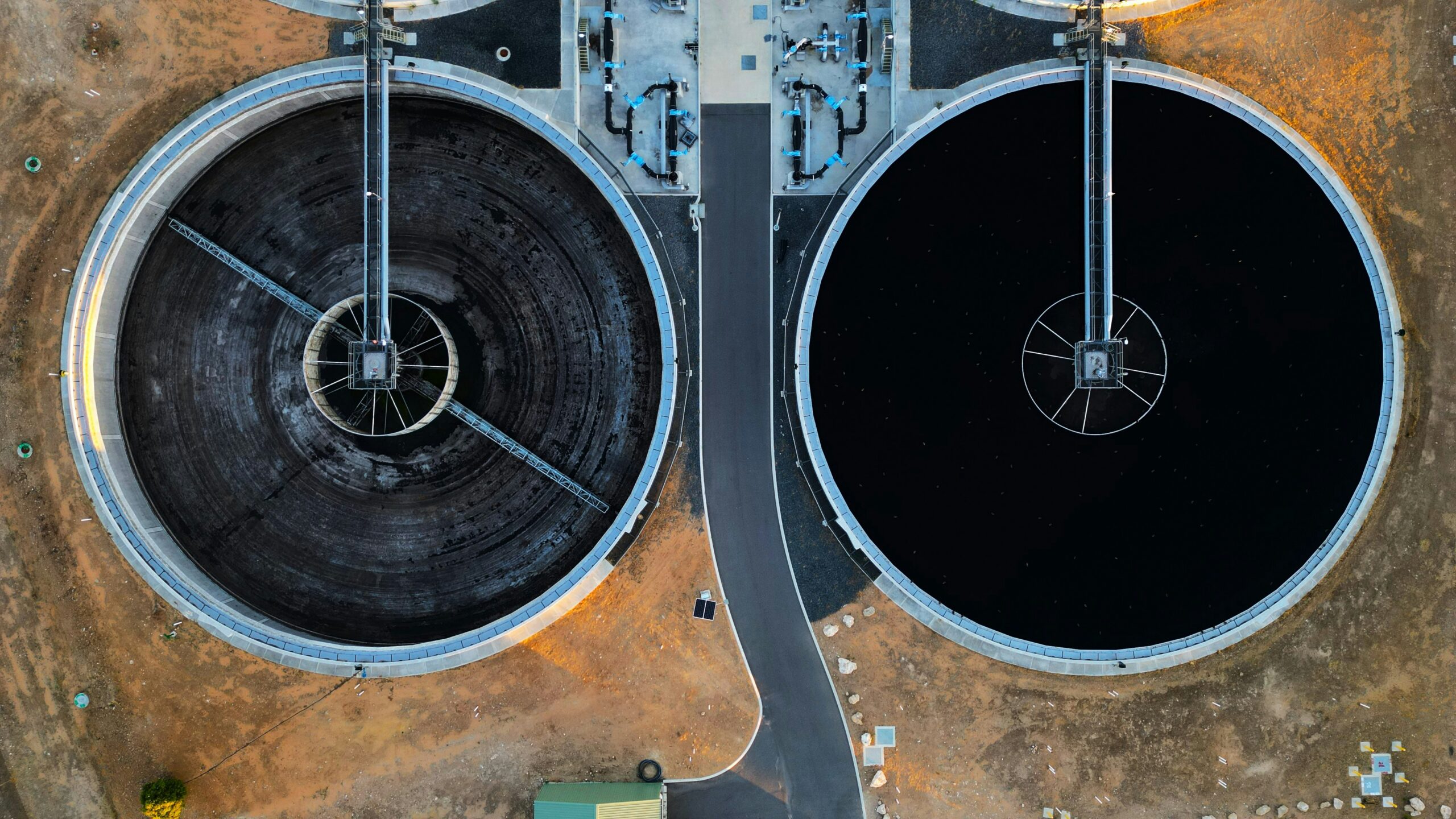
Chloe has recently completed a successful trial at Thames Water’s East Hyde sludge treatment site. Operating within a conventional digestion set-up, Chloe was positioned between the primary and secondary digestion tanks, where she extracts dissolved methane and recovers it as biogas.
The results were exactly what Bluemethane hoped for: consistently high methane concentrations, stable gas composition, lower-than-expected energy use, and delivery on time.
Most carbon capture technologies are met with some skepticism because of their cost and energy demand. Chloe is different because she is not capturing emissions after combustion. Instead, Chloe recovers methane that is already present in the sludge treatment process that would otherwise escape unused. That means valuable energy is captured before it is lost.
There is a positive balance between the energy recovered in the biogas and the energy needed for extraction. This means that Chloe delivers a clear net energy gain overall. Even without regulation driving adoption, Chloe can pay for herself to attract investment.
Chloe moves on to Anglian Water
Following the Thames Water success, Chloe has now moved to Anglian Water’s Cotton Valley site near Milton Keynes.
This site uses thermal hydrolysis pre-treatment, giving Bluemethane the chance to validate methane capture and emissions reduction across a different sludge treatment process.
The three-month pilot is funded by six UK water companies and will focus on methane capture, gas utilisation and emissions reduction.
Brutus is stabbing methane in the back downstream
Alongside Chloe’s upstream capture, Brutus has been developed to tackle methane further downstream.
Brutus interrupts methanogenesis by deactivating methanogens, the methane-producing archaea found in post-digested sludge. In simple terms, Brutus prevents methane from forming in the first place.
The technology has already demonstrated up to 99.9% inhibition of further methane production using a targeted additive combination.
Brutus is now installed at an Anglian Water site near Milton Keynes. The pilot is funded by six UK water companies, supported by the Environment Agency as project observer, and grant-supported by Innovate UK. It has also been delivered on time and on budget.
Downstream methane emissions are often invisible, unmeasured, and difficult to control. Brutus is designed to change that.
Strong momentum towards the billion-tonne goal
With successful trials, live deployments and growing backing from across the UK water sector, Bluemethane is building momentum.
Proven performance shows how scalable climate technology can move quickly when it solves real operational problems.
We look forward to watching the next phase of Bluemethane’s progress as the company works towards its ambition of preventing one billion tonnes of methane emissions.
Looking to build the next scalable climate tech venture?
Thinking of creating the next scalable climate tech company yourself? Explore Carbon13’s Venture Builder and Venture Accelerator programmes here.
You can build a company from scratch through the Venture Builder programme, which brings together 80 bright minds from technology, science and business to form teams, identify major emissions challenges and launch startups built to solve them.
Join the waitlist today to be part of the next generation of climate founders.
And if backing high-growth climate ventures is of interest to you as an investor, visit the investor page to learn more.
Finally, methane technology remains a largely untapped opportunity to generate profit while tackling the climate crisis. Explore our thought leadership here to learn how.