Welcome to Part Two of Climate Then and Now (go back to Part One if you missed it).
Carbon13 has just invested in our 100th venture, so we’re comparing the start of our journey in 2020 to 2025, and then how we’re approaching 2026.
In Part One, we were talking about the change in ventures, investment, and investability, so now let’s focus on the most important thing in Carbon13, they’re the globe we all orbit, the seeds we all water, and the gains we all sweat for: yes, it’s the founders themselves.
The People
Carbon13 is not just an investor, we are a talent investor. We are evaluating, training, supporting and investing in teams of founders as much as their neophyte startups.
Our Venture Builder and Accelerator programmes are designed and curated so that every person who leaves our programme has been trained in strategising for impact, building investable ventures, storytelling, technoeconomic analysis and pitching.
We want our programmes to benefit even those who don’t progress with a venture. Many alumni report re-engaging with their careers in more impactful ways, applying what they’ve learned to support climate innovation elsewhere.
The beginning of everything is when a person decides to start. That’s not changed.
The climate relies on very smart driven people deciding to do something about it, in our case, start a venture.
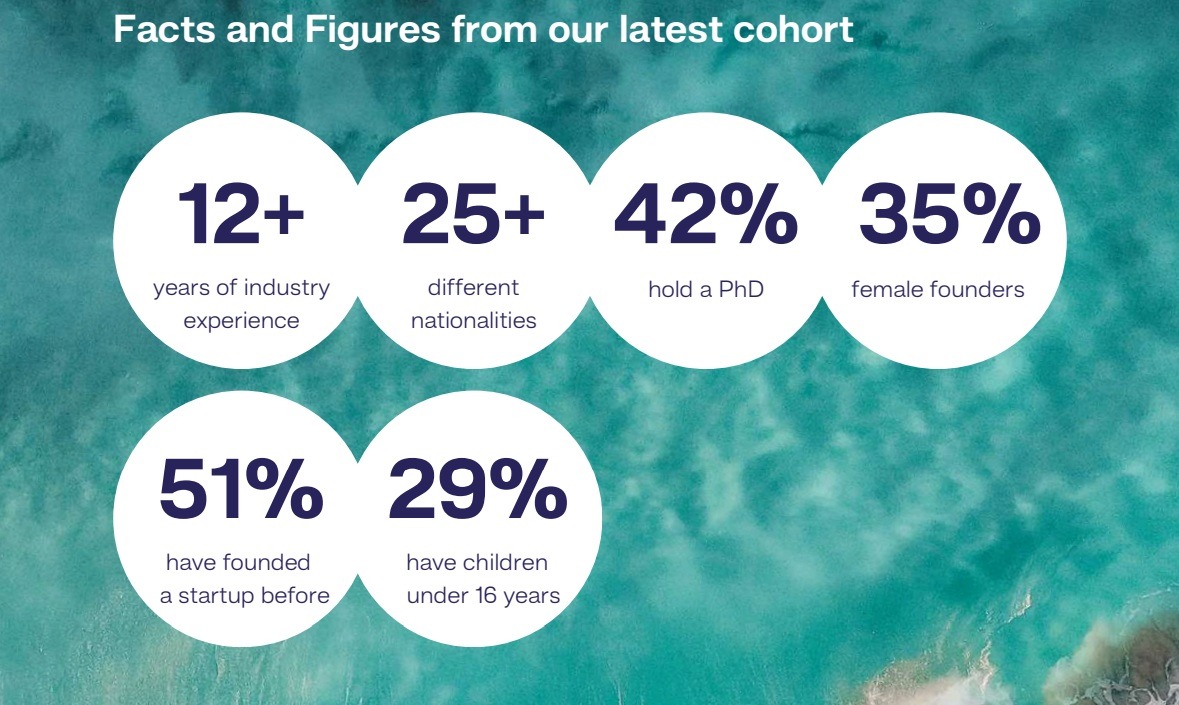
So what do those people look like? Here’s a snapshot>>>
“At its core the one thing that has not changed since I started working with Carbon13 is the ability of the programme to recognise the importance of the founding team – and I think this is and will continue to be one of the key successes of the programme. “ Sarah Dees, Entrepreneur In Residence
Sara Jones reframes the team as:
Skillsets have evolved, it’s no longer Hacker, Hipster, Hustler. It’s Scientist, Serial Entrepreneur and AI Software. That’s the dream team.”
10,000 people have applied to a Carbon13 programme, but only about 1500 have been selected to join one. We have lots of assessment criteria, but one of the most important is articulated by Michael Langguth (Cofounder of Carbon13) here:
“We really dig deep into the kind of motivation, what drives this person, why do they want to do it? Because we want to see that we have somebody in front of us who has real commitment.”
By commitment, Michael means both to the mission and to the decision to Start.
So what HAS changed?
Stephanie Alys (Director of Entrepreneurship):
“One big shift over the past few years is that climate is now attracting a lot more experienced founders. Perhaps it’s also because Carbon13 is much better known, but more people who have built companies before are choosing to do the hard thing again because the urgency of climate change is becoming more real each year. At the same time, first time founders are still arriving to our programmes with fresh perspectives and a willingness to learn and build fast, which continues to produce some of the most exciting and resilient teams we see.”
Michael adds:
“In recent years, AI engineers and people that have an AI-first mentality is something that we have increasingly looked for. Then there’s science, where synthetic biology, for example, gives us a lot of opportunities to build climate ventures in new materials or ingredients for FMCG food products.”
Sara Jones takes a view on motivation:
“When I think back to 2020 I remember this explosion of People Caring about the climate emergency. It was a “holy shit this is actually real and I can do something about it”. Those WW1 posters “Hey Daddy what did you do in the great war?” were apt. We still see tonnes of applicants saying “I’m doing this for my children’s future.”
Then in 2021-23 you saw some bandwagons just looking for what’s hot in VC. 2024-25 weeded out some bad plays and players, so now we have a maturer ecosystem better able to support talented founders.
The normalised categories of entrepreneurship have expanded incredibly. I’d been in the startup ecosystem for a decade at that point and had never met anyone who could say “I’m doing a concrete startup” or “I’m looking at industrial heat”. Now I wouldn’t blink an eyelid.
Likewise, culturally, entrepreneurship is even more normalised than five years ago. The UK and Europe ecosystems are maturing and they will develop into something unique to this continent, not following a playbook created by another.”
Do you want to start in 2026?
Applications open in January for our Venture Builder – you can apply here for the UK or here for Germany/EU.
There’s no such thing as a typical Carbon13 founder, if you want to give it your everything to launch a scalable business that impacts on a global scale in reducing emissions or solving challenges in Earth’s Vital Systems like water, biodiversity, etc, then you should apply.
Already a founder and want to start raising investment for your startup? Applications open in early 2026 for our Venture Accelerator, join the waiting list here.
Climate change
Climate change HAS changed! It got worse! Well done humanity. /s
There are bright spots, we hit peak oil (hopefully), global emissions stand a chance of flatlining soon.
But atmospheric CO2 concentrations hit 422.5 ppm in 2024, around 3 ppm higher than 2023 and 50% higher than pre-industrial levels. According to Co2.Daily we hit 428 ppm on the 4th January. In 2020 it was 414 ppm.
This is frustrating, we at Carbon13 have spent five years trying to fight the climate emergency, it’s our raison d’etre.
But building ventures in this space is a long game, it’s “patient” capital. Our oldest startups are still only 4 years old, for a category that might take 10-15 years to reach scale.
We recently released our Impact Report for 2023-2024 which is a must-read to understand our approach to impact and additionality. It’s deeply rooted in science and the latest thinking in climate.
Marina Fontoura worked on the report and has this to say
“This second Impact Report highlights what Carbon13 is doing differently from every other VC in the climate tech space. We tell the story of how we embed impact from day 1 of the venture-building journey. Our approach to impact and additionality is not an add-on; it’s at the core of how we build ventures. This report is not a conclusion, but a checkpoint and an honest look at where we are and where we need to go as we scale our ventures ecosystem.”
100 ventures. 340 million tonnes.
Our 100 ventures at the moment to our estimate have a potential planned impact of 340 million tonnes of CO2e emissions per year when at scale. 340 million is just under 1% of what humanity’s current emissions are.
Carbon13 has started our mission with a bar of 10 million tonnes of CO2e emissions reduction potential annually per startup, but we’ve never reduced problems just to pure tonnage of CO2. Our mission encompasses all of Earth’s Vital Systems and we want to build and invest in startup in areas such as biodiversity, water use, adaption and so on.
Climate “tech” in 2026
“Climate” as a category has matured into a horizontal and it’s now being joined by “cleantech” adjacent categories such as adaptation, security, and resilience.
This is echoed by Sarah Dees
“Looking toward 2026, the momentum is clearly moving toward climate adaptation and resilience technologies alongside mitigation—flood defences, drought-resistant agriculture, and cooling solutions—as businesses recognise that adaptation is no longer optional. The most exciting opportunities now lie at the intersection of AI-enabled optimisation and hard-tech climate solutions, where data intelligence meets physical infrastructure to deliver both environmental and commercial returns.” – Sarah Dees
It’s 2026, let’s get building.