Carbon13 just hit a mega milestone in our journey: we’ve made our 100th investment in a high-potential climatetech startup.
That’s 100 funded ventures through our Venture Builder and Accelerator programmes since we launched in 2020.
So as we hurtle into 2026, we’re looking back to 2020 and comparing then to now. We want to know what’s changed, what’s constant, and what’s next.
We already recorded a new podcast ep on the milestone with Nicky Dee and Michael Langguth (which you can watch here) but for a deeper dive into Climate Then and Now, we’ve gathered a lot of the OGs of the Carbon13 team to plumb the oceanic depths of our sector.
We’ve got Stephanie Alys, Director of Entrepreneurship and an Entrepreneur in Residence since the start, Min Dhillon, Investment Principal whose work with investors has fuelled our startups, Sara Jones, first employee at Carbon13 who launched the founder pipeline and brand, and Sarah Dees, Entrepreneur in Residence who’s mentored over 40 of our startups – plus of course Carbon13 cofounders Nicky and Michael.
They’ll share what’s changed, including:
- The money
- The ventures
- The investability
- The people
- The climate
And what does it all mean for climate founders in 2026?
The money – what’s changed
Let’s get some stats on the table.
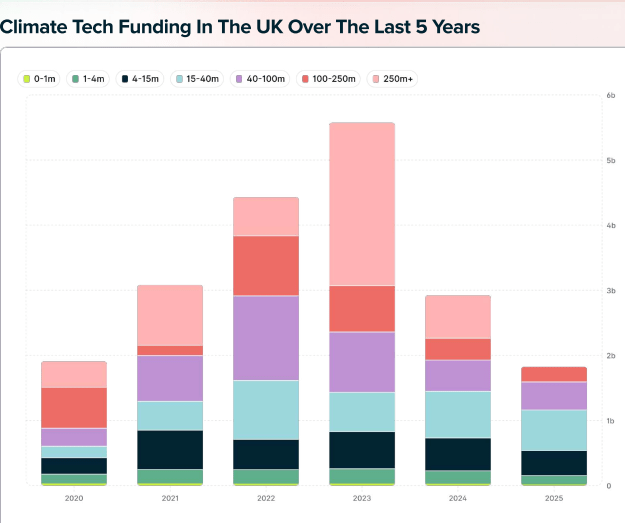
2020 was an inflection year in climate: the wave of climatetech investment was starting to swell in America, Europe and the UK. $1.9 billion was invested in the UK alone.
And the funny thing is, I can’t really give you a comparable figure for 2019 because 2020 starts to be the year where climate gets studied in its own category.
Just tracking this stat was a leap forward.
I did persist in trying to find something for you though: the best figure for 2019’s climatetech was an analysis of London climate tech startups raising $312 million in 2019. As London is about 70% of all UK deals, I think we can still say the leap to $1.9bn in 2020 is still pretty big.
And climate got even hotter. Check out this graph from Tech Nation’s 2026 report:
And then my sweet summer child, the winter kicked in. The bear chased the bull away. Markets became as illiquid as a concrete swimsuit.
Here’s Atomico’s graph from its State of European Tech:
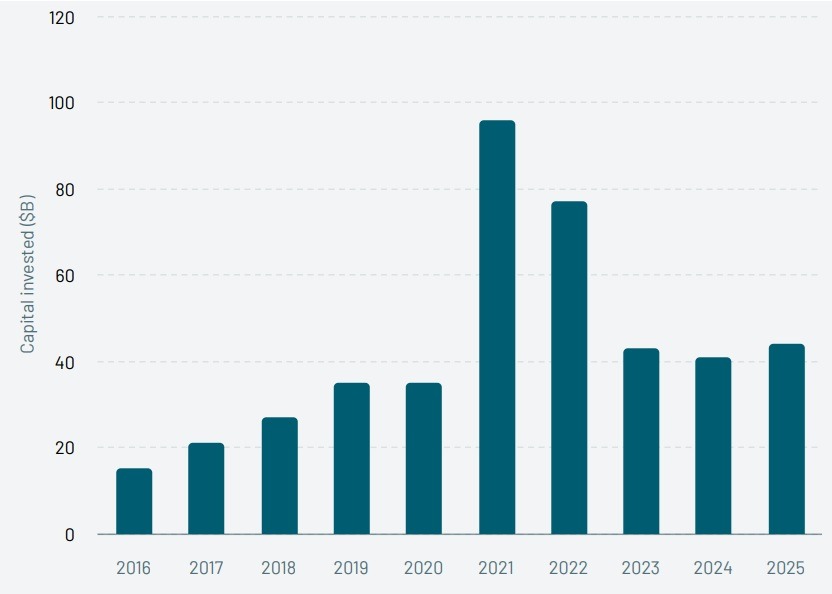
It paints a clear picture of a bubble. Next, let’s zoom out from Europe to the world and draw from Sightline Climate’s End of Year Report.
They’re reporting hot off the press that climatetech venture and growth investment reached $40.5bn in 2025, which was an increase of 8%
But the bad news is most of the growth was driven by the US, the picture remains greyer for European venture (with some complexities, see report for full brief).
This means that we go into 2026 with funding levels down on 2023, but the good news is that they’re still much bigger than 2016, and holding fairly steady.
And the really good news of course? World beating companies often get launched in a downturn, just like half the Fortune 500.
What does it mean for 2026?
There’s some green shoots for climate investment especially in specific sectors such as energy and resilience, but the investment landscape means it’s more important than ever to get the starting DNA of the company right.
That’s understanding your market, your region, having the right funding strategy, getting the best team together with the right governance, understanding your IP strategy, demonstrating real traction and product milestones to investors, customers and stakeholders.
(Exactly what the Carbon13 programmes are designed to do)
The Ventures
In 2020 the buzzwords were carbon footprints and NFTs and alternative protein. It really was a different world…
Here’s Sarah Dees:
“When I began as an Entrepreneur in Residence at Carbon13 in 2020, the climate tech landscape was dominated by carbon accounting platforms and measurement tools. Over the past five years, guiding more than 40 teams through their startup journeys, I’ve witnessed a fundamental shift from simply measuring emissions to actively decarbonising operations – across several different verticals.
The sector has matured beyond awareness-raising into deep infrastructure plays—renewable energy integration, industrial heat solutions (more to come here as we look at how to effectively run and cool huge data centres), sustainable materials, and circular economy models that embed climate action into core business processes.”
Thanks to Carbon13’s unique blend of commercial strategy and understanding of climate impact, we invested in some great companies in our 2021 cohorts: startups such as Infyos, MatNex, TierraSphere, Kita, Bluemethane, they all came from the first two cohorts.
In 2026, we’ll be seeing plenty more startups as Sarah describes them, plus one of the biggest revolutions in VC: the advent of the AI-first software startup. Moats are falling faster than a Norman Conquest and it’s re-drawing the playbook.
So let’s look at investability>>>
Investability
“In 2020, climatetech felt like a niche. Now it spans everything from deeptech materials to industrial decarbonisation. What’s amazing is that despite a tougher fundraising environment, climatetech hasn’t slowed, it’s matured. Investors are more selective, but the technologies are stronger, and the market pull for real solutions is still very much clear.” – Min Dhillon
The bar for investment even at pre-seed has risen. The competitive VC landscape and AI mean ventures often have to go further before they can raise money – especially if they’re first time founders.
Three years ago a first-time team could raise pre-seed for software with a decent pitch and an MVP. Pre-seed used to be intended to fund testing the idea, with Seed to build the prototype/product and validate the market somewhat, and Series A to turn on the taps for growth.
Now for software, pre-seed can sometimes cover all of those bases. Teams are bringing AI-built products and a pipeline of pilot projects and traction slides with a level of detail not often seen at Seed let alone Pre-seed.
So for founders exploring the Carbon13 Venture Builder in 2026 (applications open on 12 January!!!), heed this advice from our CEO, Nicky Dee:
“The climatetech space has become more sophisticated. We’ve got a better understanding of not just the tech, but where the commercial opportunities are. And increasingly, we do expect founders to enter with some sort of an idea, either a commercial frustration or a technical trajectory that they’ve been pursuing for the last few years. We love that because most of our teams typically do hit the ground running.”
And for deeptech startups in 2026, investors ears are pricking up when they see a team with complementary skills, (and either direct experience or deep understanding of the target industry), a well done techno-economic analysis, and evidence the team can progress through the TRL levels.
So the bar’s raised for founders. They’re the beating heart of Carbon13 and the focus of our mission.
So, how have THEY changed since 2020?
Hit the button for Climate Then and Now – Part Two
Newsletter
Join Carbon13’s community to follow our startups’ progress, including news, raises, events and job opportunities.

This website is not an offer to buy or sell securities and does not constitute a Direct Offer Financial Promotion. Applications for investment may only be made on the basis of the relevant documentation, copies of which are available on request. No reliance is to be placed on the information contained in this website in making such an application. Information herein is not intended to, nor should be taken to, constitute advice. This material is directed only at persons in the UK.
Please note that the content and information provided on this platform may be confidential and for information and illustration purposes only. None of the documentation made available to you via this platform is legally binding, constitutes any financial or other obligations and must not be considered as legal, commercial or any other advice or recommendation by Carbon13 Group or any of its affiliates.
This website is produced by Carbon13, which has engaged AQ1443 Ltd (A company registered in England and Wales with registration number 13994528) (trading as ‘Thema’) to undertake the regulatory activities of making arrangements with a view to transactions in investment. Thema is authorised and regulated in the United Kingdom by the Financial Conduct Authority (“FCA”) (registration number: 978496).
Copyright ©2023 Carbon13 Salisbury House, Station Road, Cambridge, CB1 2LA. All rights reserved.
RISK SUMMARY
Estimated reading time: 2 min
Due to the potential for losses, the Financial Conduct Authority (FCA) considers this investment to be high risk.
What are the key risks?
1. You could lose all the money you invest
- If the business you invest in fails, you are likely to lose 100% of the money you invested. Most start-up businesses fail.
2. You are unlikely to be protected if something goes wrong
- Protection from the Financial Services Compensation Scheme (FSCS), in relation to claims against failed regulated firms, does not cover poor investment performance. Try the FSCS investment protection checker here.
- The Financial Ombudsman Service (FOS) will not be able to consider complaints related to this firm] or [Protection from the Financial Ombudsman Service (FOS) does not cover poor investment performance. If you have a complaint against an FCA-regulated firm, FOS may be able to consider it. Learn more about FOS protection here.
3. You won’t get your money back quickly
- Even if the business you invest in is successful, it may take several years to get your money back. You are unlikely to be able to sell your investment early.
- The most likely way to get your money back is if the business is bought by another business or lists its shares on an exchange such as the London Stock Exchange. These events are not common.
- If you are investing in a start-up business, you should not expect to get your money back through dividends. Start-up businesses rarely pay these.
4. Don’t put all your eggs in one basket
- Putting all your money into a single business or type of investment for example, is risky. Spreading your money across different investments makes you less dependent on any one to do well.
- A good rule of thumb is not to invest more than 10% of your money in high-risk investments.
5. The value of your investment can be reduced
-
The percentage of the business that you own will decrease if the business issues more shares. This could mean that the value of your investment reduces, depending on how much the business grows. Most start-up businesses issue multiple rounds of shares.
-
These new shares could have additional rights that your shares don’t have, such as the right to receive a fixed dividend, which could further reduce your chances of getting a return on your investment.
If you are interested in learning more about how to protect yourself, visit the FCA’s website here.